
I have been remiss with my Pictorial Palettes as of late– infuriatingly so, because I truly do love these romantic indulgences of conjecture and color. So I am reinstating the tradition with Edward Hopper’s 1939 piece “”New York Movie.” A departure from our previous palettes, which were full color photo portraits or film stills, this is a celebrated piece of art from one of America’s foremost modern artists.
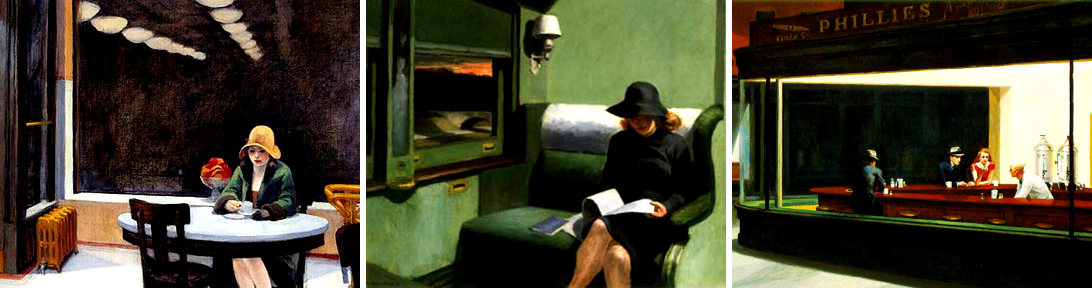
Edward Hopper’s realistic visualizations of early/mid 20th century America– from “Automat” to “Compartment C” to his seminal “Nighthawks”– are candid, rarely pretty, always pensive and often melancholy. The ominous, dark reality of the brightly lit American Dream, Hopper’s paintings (for me, anyway) are to American art what Charles Bukowski was to American literature and David Lynch is to American film.
Hopper began his career as a rather reluctant illustrator and, as a freelancer, even designed movie posters. He was an avid movie-goer, and as “New York Movie” shows, was intimately familiar with them. The National Gallery of Art made the observance of this particularly mysterious piece that the movie itself is not the focus here– indeed the image itself is undecipherable– but rather the focus is on the mood and atmosphere of the theater. And, of course, Hopper’s thoughtful usherette. Her interest in the film has, visibly, long since waned and the realities of her own life eat at her there under Hopper’s dim orange glow. Hers is a beautiful, stately silhouette, one you can easily envision draped in a satin gown by Orry-Kelly in an MGM melodrama.
Offset by the ornate movie palace decor of the period, Hopper succeeds in effectively conjuring a figure of loneliness and melancholy. As Gardner’s Art Through the Ages points out, “motion is stopped and time suspended, as if the artist recorded the major details of a personal memory… [Hopper produced] paintings of overwhelming loneliness and echoing isolation of modern life in the United States.” In “New York Movie,” the movies are still a means of escape to the Depression-era moviegoers in the audience, but for Hopper’s usherette the smoke and mirrors have dissipated and all that’s left is the cold reality waiting outside.



 Kitty Packard's Pictorial
Leave a reply to The Lady Eve Cancel reply